Now at SIIM 2026 · Startup Kiosk 3 · June 10–12

CuratAI · AI-Native Multimodal Data Curation Platform

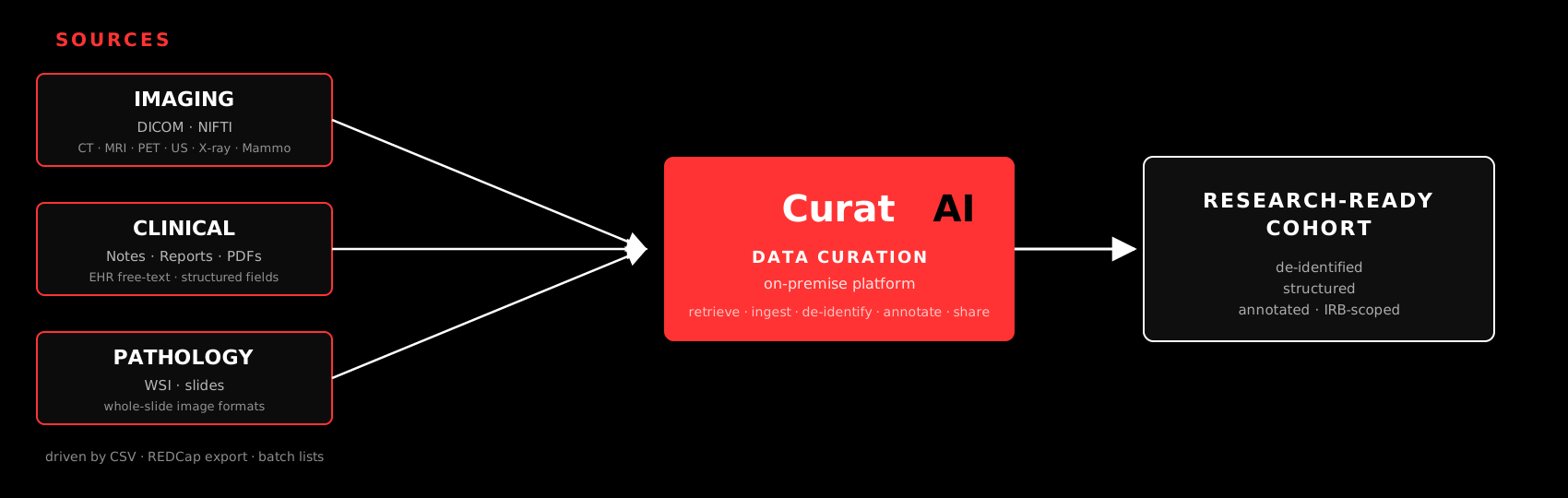
An on-premise multimodal data curation platform for clinical research — six on-premise stages, end to end

Retrieval, ingest (unstructured → structured), de-identification across all five PHI vectors, AI-assisted annotation, custom AI plugin slot, cross-institution sharing. Inside the institutions that already do the work.

Stage 1 · Retrieval

Multi-source. Multi-modal

Pull from PACS, EHR, and pathology systems. Batch via REDCap, Excel, or CSV exports — whatever shape your research data is already in. One pipeline for every modality you work with.

Multi-source retrieval

PACS, EHR, pathology. Batch pulls driven by REDCap, Excel, or CSV.

Multi-modal coverage

DICOM, NIfTI, WSI, PDF, clinical notes. One pipeline.

Connectors and queues

Configure once. Studies arrive automatically as they're scanned or charted.

Multimodal data sources flowing into CuratAI

Stage 2 · Ingest

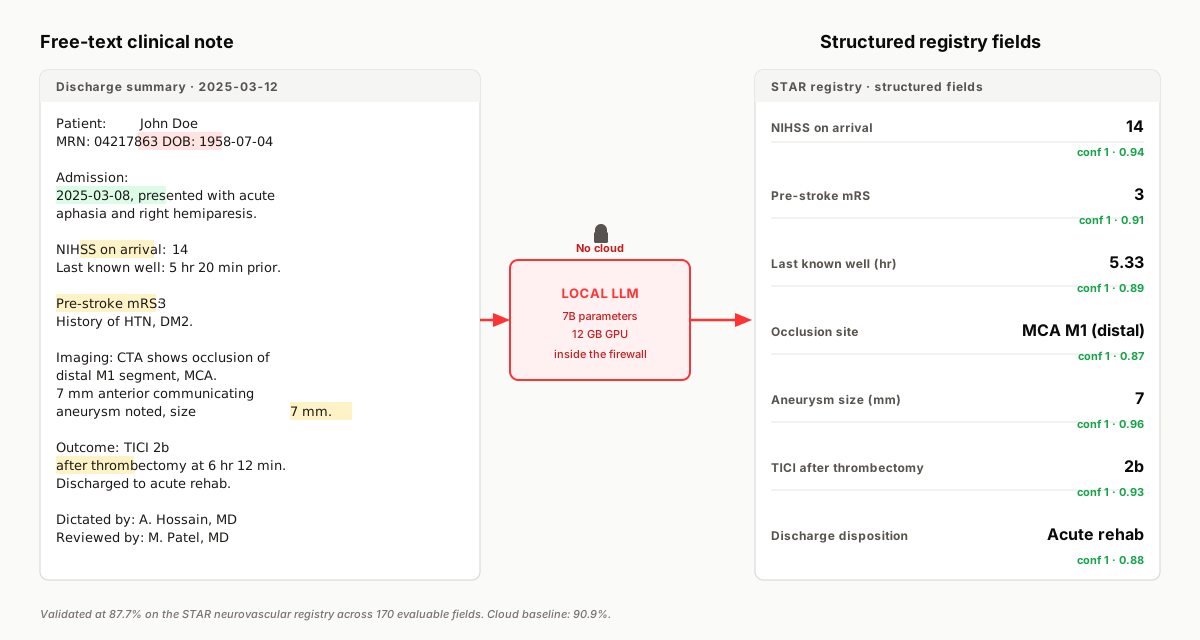
Unstructured → Structured — local LLM

Pulls structured fields out of free-text clinical notes, reports, images, and PDFs. Adapts to each target registry's structure. A local 7B model on a 12 GB consumer GPU is enough; accuracy depends on the registry.

A free-text clinical note on the left flows through a local LLM (7B params, 12 GB GPU, inside the firewall) into structured registry fields on the right, with per-field confidence scores
Free-text clinical note → structured registry fields. The LLM runs inside the institution; no PHI leaves the firewall.

Validation — STAR Neurovascular Registry

The Stroke Thrombectomy and Aneurysm Registry (founded at MUSC, 85+ sites, 15,000+ patients) requires structured abstraction across 341 fields per case from the H&P, procedure note, and discharge summary. We validated on 29 patients, 170 evaluable fields, against the site's REDCap ground truth.

Field typenCuratAI 7BCloud baseline
Yes / No4991.6%92.3%
Multiple-choice2375.6%79.6%
Cascaded9490.1%93.2%
Free text453.4%57.1%
Overall17087.7%90.9%

Confidence-triaged workflow

  • 86% of fields land at confidence 1 with ~89% accuracy — auto-accept.
  • 14% land at confidence 2 or 3 — surfaced for human review.
  • End-to-end: 26 min per patient across 341 fields.

Local 7B reaches 87.7% overall on a complex neurovascular registry — within 3.2 points of the cloud baseline. Registry-agnostic prompts; the same engine ports to GWTG-Stroke, oncology, and custom institutional registries.
Automated Population of the STAR Neurovascular Registry Using a Local Language Model. Submitted to Neurosurgery, 2026.
Stage 3 · De-identify

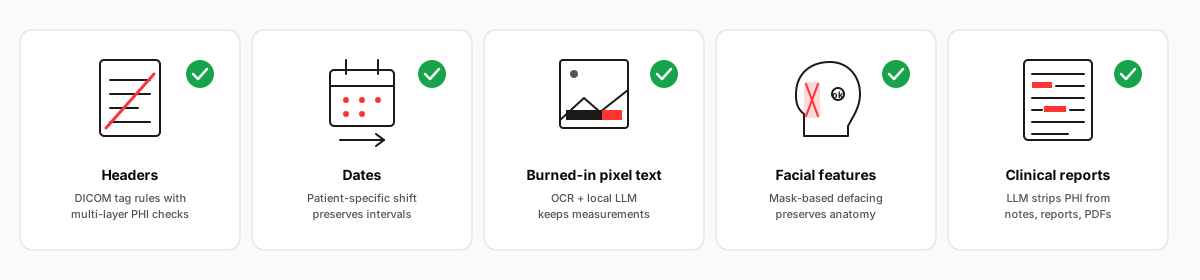
PHI lives in 5 places. We cover all of them

Headers, dates, burned-in pixel text, facial features, and clinical reports. Each gets a dedicated mechanism — naive blanket-blackouts destroy research utility.

Five icon cards — headers, dates, burned-in pixel text, facial features, clinical reports — each marked with a green check confirming PHI coverage
  • Headers — Rule-based DICOM de-id with multi-layer PHI checks (known, residual, user-defined fields).
  • Dates — Patient-specific random shift. Identity gone; longitudinal structure kept. Details ↓
  • Burned-in pixel text — OCR plus local-LLM reasoning. Retains research-critical text; removes PHI only. Details ↓
  • Facial features — Mask-based defacing that preserves intracranial anatomy. Details ↓
  • Clinical reports — On-prem LLM strips PHI from notes, reports, and PDFs while preserving clinical meaning. Validated on i2b2 2014 (514 discharge summaries, 2,883 patient/clinician names).
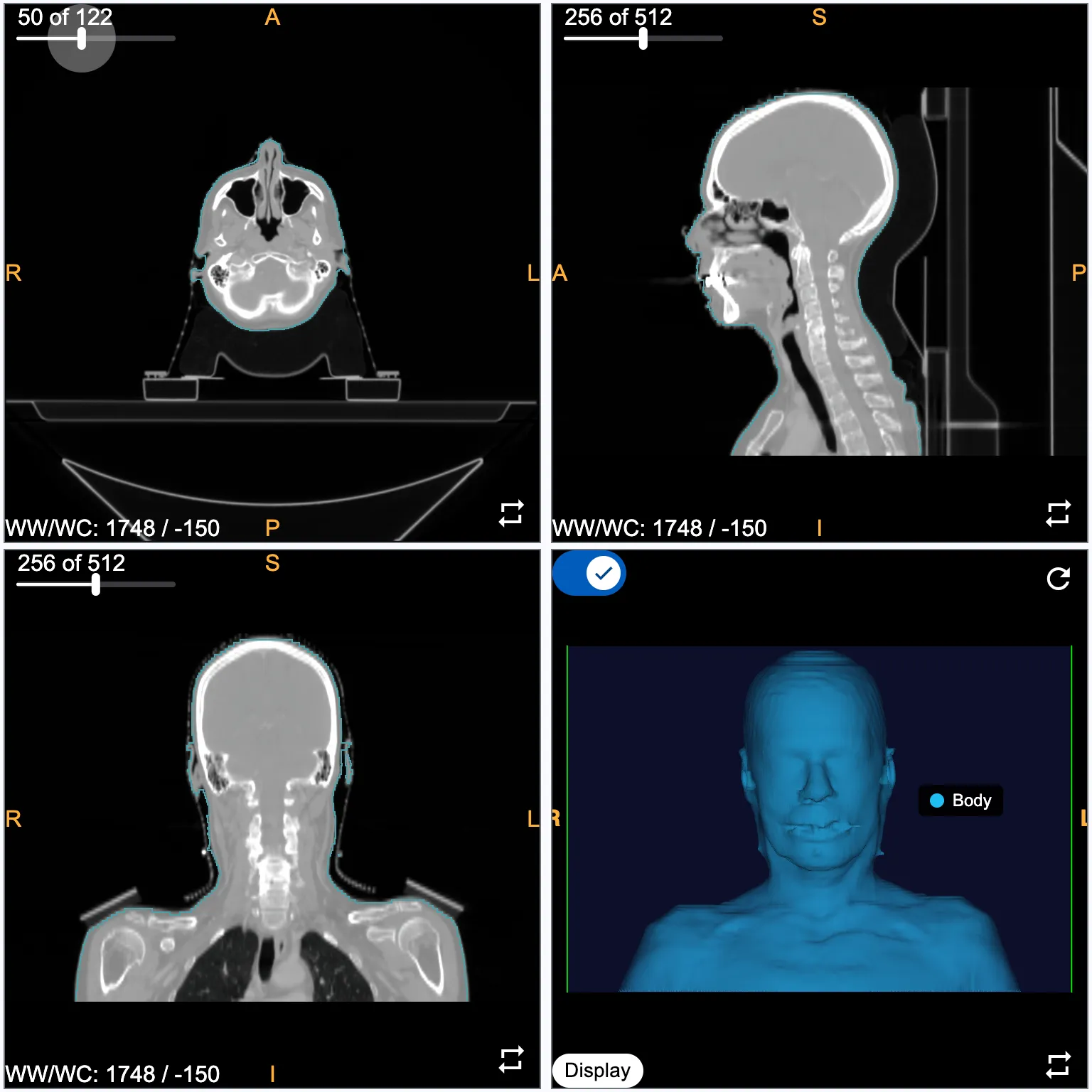
Before Original
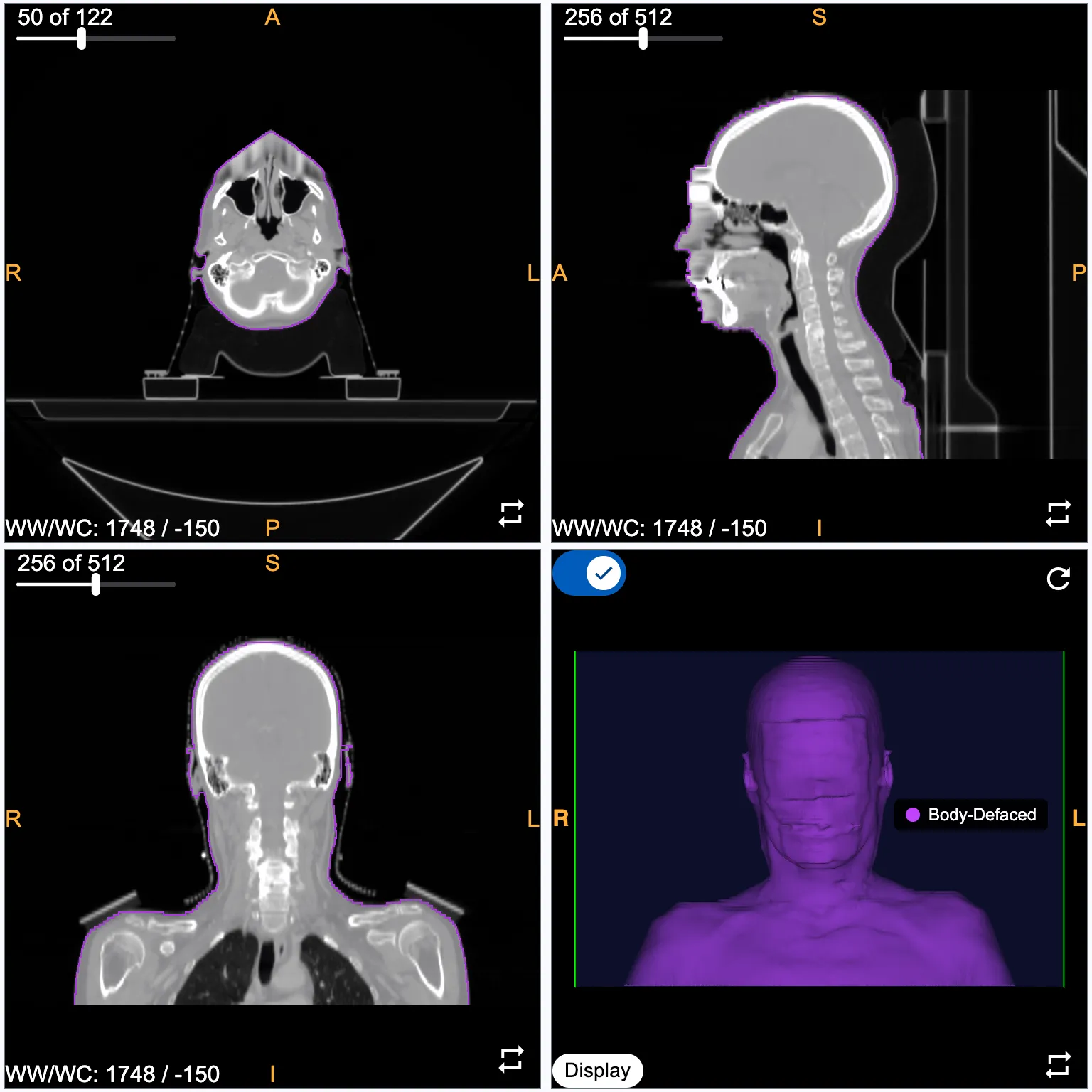
After Defaced
Drag to compare

Facial features

Mask-based defacing removes facial geometry while leaving brain, skull base, and surrounding anatomy untouched. Penn benchmarked four defacing algorithms — CuratAI's delivered the best privacy–utility trade-off.

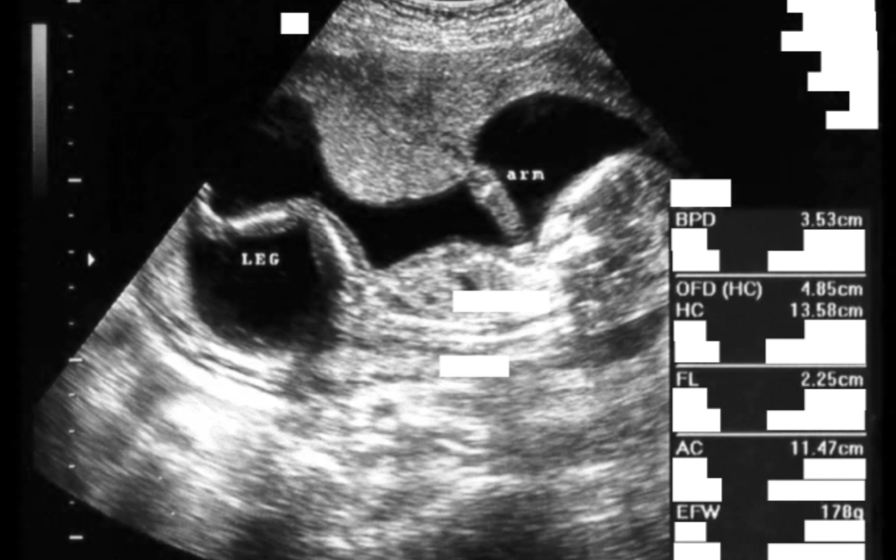
Original ultrasound and CT panels with burned-in text — PHI removed while measurements and modality markers are preserved

Burned-in pixel text

OCR plus local-LLM reasoning classifies each detected region. PHI is replaced; measurements, scale bars, side markers, and modality annotations are preserved — so the image stays readable for research.

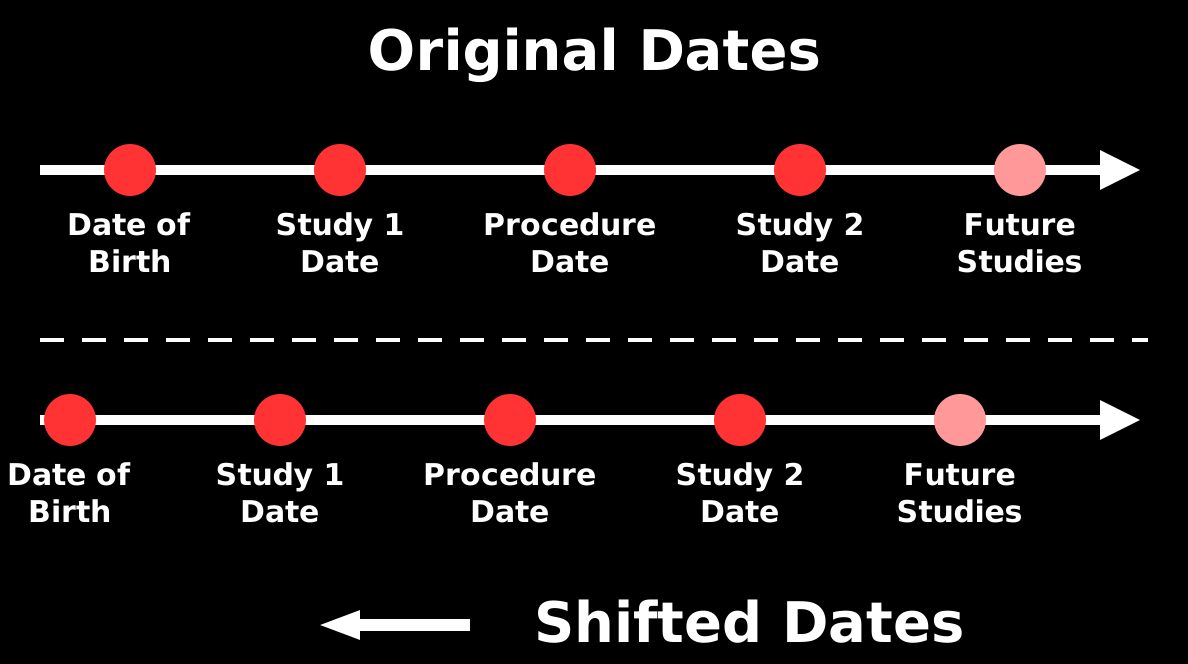
Patient-specific date shifting — absolute dates removed, intervals between studies preserved

Date-interval retention

A patient-specific random offset removes the absolute date but preserves the intervals — baseline to follow-up, procedure to discharge, treatment to event — exactly.

Stage 4 · Annotate

AI-assisted annotation

The hidden bottleneck in every research pipeline is the graduate student clicking 12,000 scans. Prediction and interpolation turn a 6-month clicking project into a 3-week supervision project.

Web-based, no install

Runs in the browser. No per-workstation install, no IT ticket to onboard a new annotator.

Prediction + interpolation

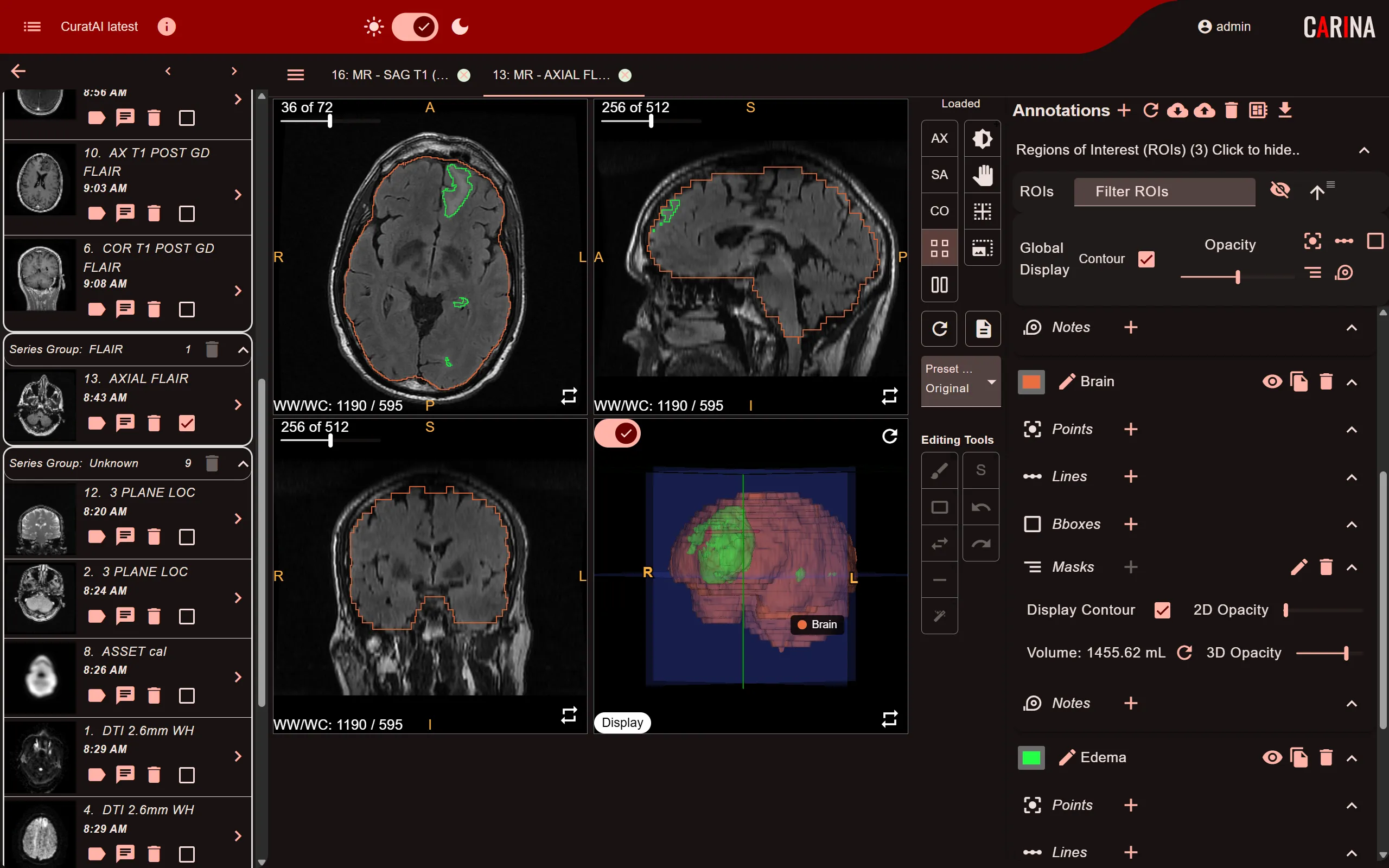
Annotator draws on representative slices; the model predicts and fills in the rest of the 3-D segmentation. Reviewer corrects what's needed.

Multi-user roles

PI, annotator, and reviewer roles with shared queues and live cursors. Reviewer approval baked in.

Fully traceable

Every edit logged with user, timestamp, and reversible diff. Inter-observer variability is visible in the viewer.

Multi-planar + 3-D

Linked axial, sagittal, coronal, and MIP views, plus 3-D rendering. DICOM-RT, NIfTI, and DICOM-SEG export.

CuratAI annotation viewer with AI-assisted annotation and multi-user assignment

Stage 5 · AI Plugins

Run your own AI models on your de-identified cohort

CuratAI's plugin slot is what makes it a platform: your research question, our stack, your model — running on your hardware, inside your firewall, on data that stays inside the institution.

Drop a folder, register a model

Any language — Python, C++, R, MATLAB, Julia. CuratAI handles the data plumbing, the cohort selection, the I/O contracts.

Runs on your hardware

GPU on the same workstation, on a local Linux server, or on your institutional compute. No cloud, no telemetry, no PHI off-site.

Same de-identified cohort

Your model trains and infers on data that's already passed pixel-level PHI removal, audit logging, and IRB-scoped project access.

Stage 6 · Collaborate

Cross-institution sharing — guarded to be PHI-free

A dataset becomes research-grade when it's shareable across collaborators without ever being exported as raw files.

PHI-free guard

Share is blocked unless every artifact has cleared the de-identification pipeline; nothing leaves the institution while it still contains PHI.

Signed project tokens

Scoped, time-bound access to a specific de-identified project — no raw-file handoffs.

Federation across sites

Same project visible to collaborators at other institutions, IRB-scoped.

Reversible — with key

Re-identification is possible internally with the linking file; never on the receiving side.

Deployment

Inside the institutions that already do the work

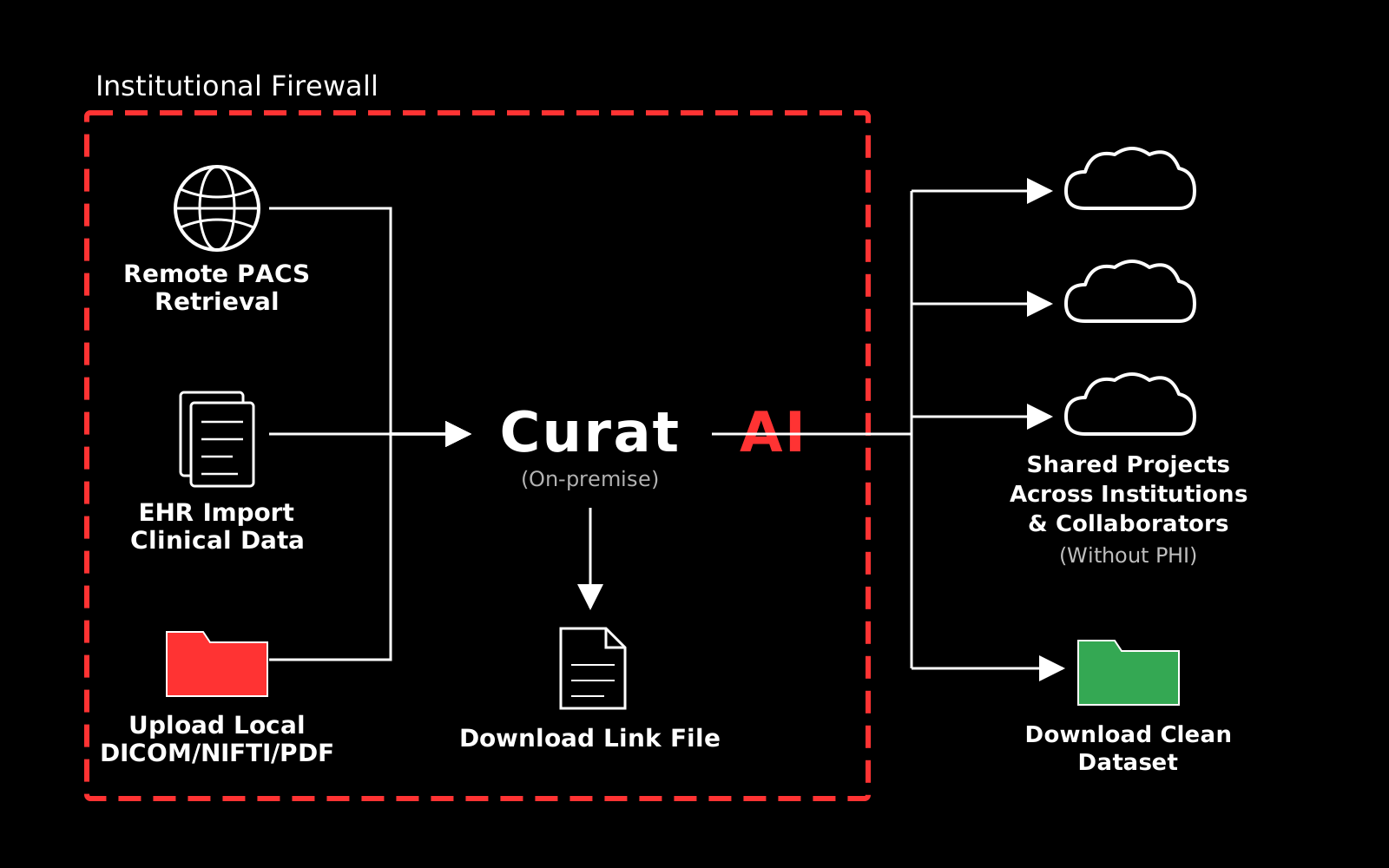
CuratAI on-premise architecture: PACS retrieval, EHR import, and local upload feed CuratAI inside the institutional firewall; only de-identified shared projects cross out by explicit user action.
Inputs and processing stay inside the institutional firewall. Only de-identified shared projects cross out — by explicit user action.

CuratAI runs entirely inside your institution's network. The full stack — application, database, on-premise large language model, custom-model runner — installs on a Windows workstation or Linux server you control. No cloud component, no telemetry, no outbound connection that carries patient data. The linking file required for re-identification stays inside your firewall.

  • Audit logs remain local to your installation.
  • Re-identification linking files stay on your storage; CuratAI never transmits them.
  • Exports are explicit user actions.
  • Cross-institution sharing is gated by per-project safeguards.
  • HIPAA-aligned
  • Audit-ready
  • IRB-compatible
  • No cloud, no external BAA

And then — the same stack

Research today, FDA-cleared product tomorrow

A research group can de-identify on Monday, annotate by Friday, train the following weeks, publish in months, and ship as an FDA-cleared product on the same stack. Same company, same deployment footprint, same team.

See the clinical AI products built on CuratAI's stack: INTContour (FDA-cleared auto-contouring), OncoAI Suite, QuantBrain, and INTDose.

Curate your next cohort with CuratAI